Baklava
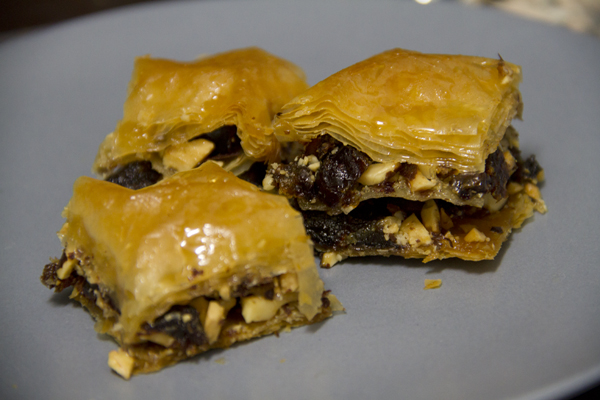
**Whole kitchen en su Propuesta Dulce para el mes de Noviembre nos invita a preparar un clásico persa Baklava. **Al parecer este pastelito tiene su origen en la antigua Mesopotamia aunque todavía hoy siguen disputándose varias culturas y civilizaciones su creación. Persa, griego o árabe, está buenísimo. En esta ocasión hemos preparado dos versiones; una con dátiles y almendras tostadas y otra con avellanas y chocolate. La pasta filo es una maravilla de la cocina que no podéis dejar de probar tanto para dulce como para salado.
¿Qué necesitamos?
1 paquete de pasta filo
100 g de mantequilla
Para el almíbar:
210 ml de agua
180 g de azúcar
30 g de miel
Zumo de medio limón
Una ramita de canela
Para el relleno:
18 dátiles
50 g de almendras tostadas
50 g de chocolate (en gotas o perlas)
50 g de avellanas
¿Cómo lo hacemos?
Empezamos haciendo ****el almíbar. Ponemos todos los ingredientes en una cazuela y, a fuego fuerte, lo llevamos a ebullición. Bajamos un poco el fuego y dejamos cocer durante 15 minutos aproximadamente para que espese.
Precalentamos el horno a 180ºC.
Preparamos el relleno: deshuesamos los dátiles y los partimos en trozos pequeños. Troceamos también las almendras y las avellanas. Mezclamos en un cuenco los dátiles con las almendras y en otro las avellanas con el chocolate.
Derretimos la mantequilla unos segundos en el microondas.
Untamos la fuente que vayamos a usar con mantequilla y cortamos todas las láminas de pasta filo del tamaño de nuestra bandeja.
Ponemos una lámina de pasta filo, y con un pincel, o con las manos, la embadurnamos de mantequilla por una cara. Ponemos otra capa y volvemos a untarla con la mantequilla. Así hasta tener 8 capas.
Ponemos la mitad de nuestro relleno de dátiles y almendras y lo extendemos sobre la pasta filo.
Volvemos a poner pasta filo. Esta vez, 4 capas (siempre untándolas con mantequilla para que al hornearlas se queden separadas).
Echamos el resto del relleno de dátiles y almendras.
Hacemos otra tanda de 8 capas de pasta filo (siempre untadas con mantequilla).
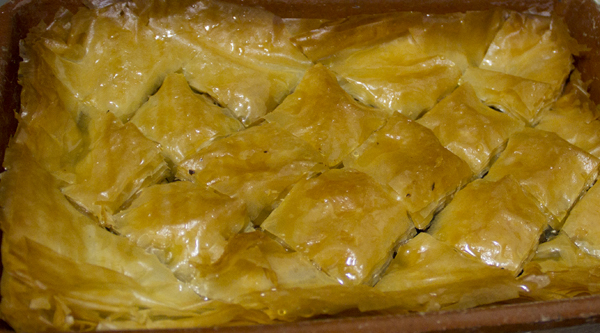
Con un cuchillo afilado cortamos el baklava en cuadrados.
Horneamos 45 minutos en total, los 20 primeros destapado, y los 25 siguientes colocando papel de aluminio sobre el baklava para que no se dore demasiado.
Nada más sacarlo del horno, dejamos reposar 5 minutos, y vertemos el almíbar frío sobre el baklava caliente (así seguirá estando crujiente).
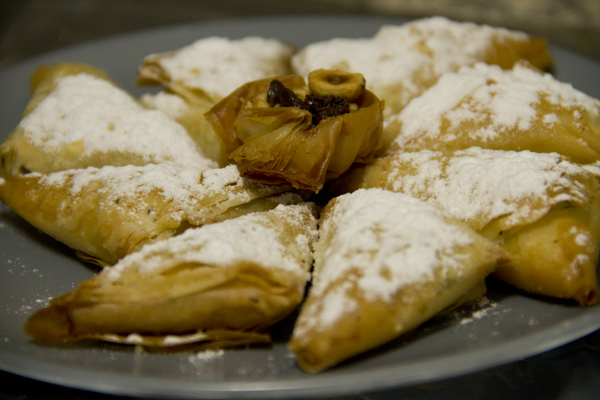
Para la versión de avellanas y chocolate podéis repetir el mismo proceso en otra fuente de horno o bien hacer triángulos. Para ello cortamos la pasta filo en tiras de 5 cm por 20 cm (aproximadamente). Embadurnamos con mantequilla cada capa y ponemos 4 tiras juntas.
Ponemos una cucharadita de relleno en un extremo y doblamos una esquina para formar un triángulo con el relleno en el interior. Cogemos el otro extremo y vamos plegando el triángulo sobre sí mismo. (Como es un tanto complicado de explicar, he encontrado [este vídeo](
{{}}
) donde podéis ver fácilmente cómo hacerlo).
Los horneamos también a 180ºC pero en 10-15 minutos estarán listos.
Al sacarlos los podemos espolvorear con azúcar glas por encima.
Consejos:
La pasta filo se seca enseguida así que cuando no la estés utilizando, guárdala bien en una bolsa de plástico.
Es importante echar la mantequilla entre cada capa pero tampoco es necesario “ahogarla”.
Es un dulce bastante contundente así que es preferible hacer los cuadraditos pequeños.
[English version] BAKLAVA* *Ingredients:
1 package of filo pastry
100 g butter
For the syrup:
210 ml water
180 g sugar
30 g honey
Juice of 1/2 lemon
Cinnammon stick
For the filling:
18 dates
50 g almonds
50 g chocolate (drops or chips)
50 g hazelnuts
* *
Combine the syrup ingredients in a medium saucepan and bring to boil. Let the syrup simmer on low heat for about 15 minutes
Preheat oven at 180ºC.
*Now prepare the filling: pit the dates and chop into small pieces. Chop almonds and hazelnuts. Mix almonds and dates into a bowl and chocolate and hazelnut in other. *
Melt the butter in the microwave for a few seconds.
Butter the baking pan and cut the filo pastry sheets into the size of the baking pan.
*Place a sheet of filo pastry and butter it. Place another sheet over it and butter again. Do it again until having 8 layers. *
*Scatter half of the dates-almonds filling. *
*Place more filo pastry. This time, only 4 layers but always buttered. It will make to have separate layers once the baklava is baked. *
*Add the other half of the filling. *
*Create another pack of 8 layers of filo pastry (always buttered). *
*With sharp knife cut baklava into small squares. *
*Bake for 45 minutes. The first 20 minutes uncovered and then you can cover with aluminium foil to prevent it from browning too much. *
When you take it out from oven, let stand for 5 minutes and then pour the cold syrup.
For the hazelnut-chocolate version, you can follow the same steps or make small triangles of filo pastry. For the triangles, cut the pastry into stripes (4 x 20 cm aprox.). Butter each stripe and put 4 of them together.
*Add a tsp of the filling in one of the sides and proceed to fold into triangle shape. You can see how to do it easily in [this video](
{{}}
).*
Bake at 180ºC only for 10-15 minutes.
You can powder some confectioners’ sugar when you take them out from oven.
* *
Tips:
*- Filo pastry dries very fast, so when you are not using it, keep it in a plastic bag. *
- It’s important to butter every single sheet (layer) of filo pastry but don’t “over butter” (otherwise, it will be too greasy).
- It’s a filling sweet, so make small squares when cutting the baklava.